| 2025-02-19 |
Longer holding time |
After the accidental warm-up, followed by 12 days of pumping
before re-cooling, the holding time of NOTCam is now longer than before.
|
| 2025-01-14 |
New feature on detector |
A thread-like, dark feature has appeared in the lower left quadrant of the
NOTCam array (about 2.5 pix wide). It is to be investigated and removed at
next opportunity to open the instrument.
|
| 2024-12-27 |
NOTCam pumping in the dome |
Failure to access the telescope during Christmas days, because
of a large amount of snow, and an electrical storm that took
out power (stopping the PTR), caused NOTCam to warm up 25/12.
Pumping of NOTCam started in the dome on 27/12
and good vacuum was reached again within a short time. The
PTR was started and NOTCam cooled with LN2 on 08/01-2025.
|
| 2024-07-06 |
NOTCam Opening
07 - 24 Jun 2024 |
NOTCam was set to warm up in the morning after observations
on June 7th, was translated to the service building and opened
on June 10th. The KDP crystals were taken out and stored in a
dry environment while the instrument was being open to air.
The charcoal getter was set to baking and the pressure sensor
cleaned. A new filter NB2390 was installed in filter wheel 1.
On June 11th just before closing, the KDP crystals, including
the new KDP_0.5mm were all installed in slots the aperture
wheel. The warm getter was installed, and NOTCam was closed
according to procedure and set to pumping. The vacuum behaviour
was nominal, except for a shorter event of outgassing
during the first hours. Transport back to the dome 17/6 and
pumping continued, pressure at 2E-04 mbar.
|
| 2023-09-06 |
Pumping while cold |
NOTCam was put on the pump while being kept cold to improve the vacuum.
|
| 2021-11-03 |
NOTCam Opening
03 - 29 Nov 2021 |
The vacuum was bad and it was decided to warm up and open. NOTCam
was transported to the SB and a leak test was done before opening,
but with no clear results. No apparent cause of the vacuum loss
was found inside after opening and inspection. The charcoal was
removed and baked, and o-rings were cleaned. Waiting as long as
possible for a CaF2-sandwiched KDP to arrive (for pre-NTE testing),
but eventually NOTCam needed to be closed and was set to pumping.
|
| 2021-07-17 |
Filter measurements at the IAC lab |
The NOTCam filters #213 (He IA), #214 (Pa gamma), #215 (J-continuum), #216 (Pa beta), #222
(Yn), #236 (Y) and #237 (Z) were measured by the IAC lab.
See plotted curves of
transmission and
optical density.
|
| 2021-07-16 |
New KDP tests |
The KDP crystals were remounted in NOTCam in order to test again their behaviour
during cooling down. Check the report here:
New KDP test report.
|
| 2021-06-22 |
NOTCam Opening
22 Jun - 14 Jul 2021 |
This was a scheduled opening of NOTCam in order to unmount 7 filters
and pack them for transport to the IAC for transmission measurements
as requested by the NTE team and to re-install two KDPs for NTE tests.
The filters
when back from the IAC were re-installed in the same wheel slots as
before. The spare H and K filters
that had been in the stop-wheel were dismounted and sent to Copenhagen
for NTE use. The aperture wheel was checked, the pressure sensors
were cleaned, and the charcoal getter was baked.
Two KDPs arriving from
Copenhagen were installed in the aperture wheel slot 2 and 9 in an
environment in the clean room of 30 degrees Celcius and a relative
humidity of 14%. The time from opening the KDP boxes to having NOTCam
closed and pumping was limited to < 3 hours. The idea was to redo the
KDP tests from 2016, but now with a long warm pumping before cooling, in
order to avoid any condensations on the KDPs, the hypothesis.
|
| 2020-11-11 |
New trolley wheels |
The NOTCam trolley was upgraded with new wheels, bigger and harder, so
now the heavy NOTCam instrument can roll over the dome floor again.
|
| 2020-08-19 |
New instrument computer |
NOTCam was upgraded with a new computer "tessa" as a replacement
of the previous instrument computer "marissa". Note that the observing
system is started from "selena". The Cookbook has been updated.
|
| 2020-04-16 |
Warm-up on pump |
NOTCam was set to warm-up while being connected to the vacuum pump on
April 16th. The pumping was going on until the temperature inside NOTCam
was above zero, and that took 20 days. Then the LN2 tank was pumped with
the 2nd turbo pump, using silica gel to avoid water in the pump. After
this the tank was flushed with dry air. The PTR was started again on
May 4th, and LN2 cooling started on May 5th. The vacuum pumping was
continuing all the time until NOTCam reached operating temperature. This
was found to be crucial, as the LN2 filling in a warm cryostate usually
caused vacuum losses due to the design of the fill/vent tubes. The pressure
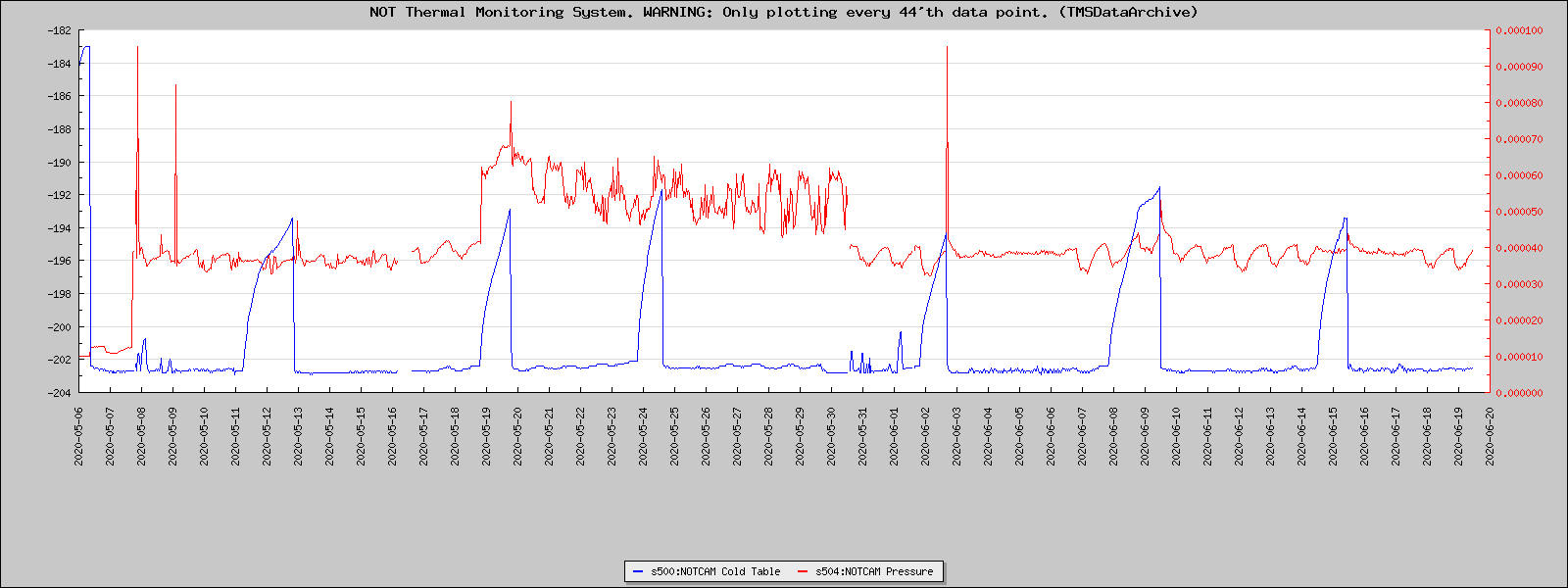
inside NOTCam is now typically 4E-05 mbar and the holding time is 6 days
with the cold table at a stable temperature until the tank gets emptied
of LN2, i.e. a substantial improvement. See
TMS plot May 6th - Jun 20th
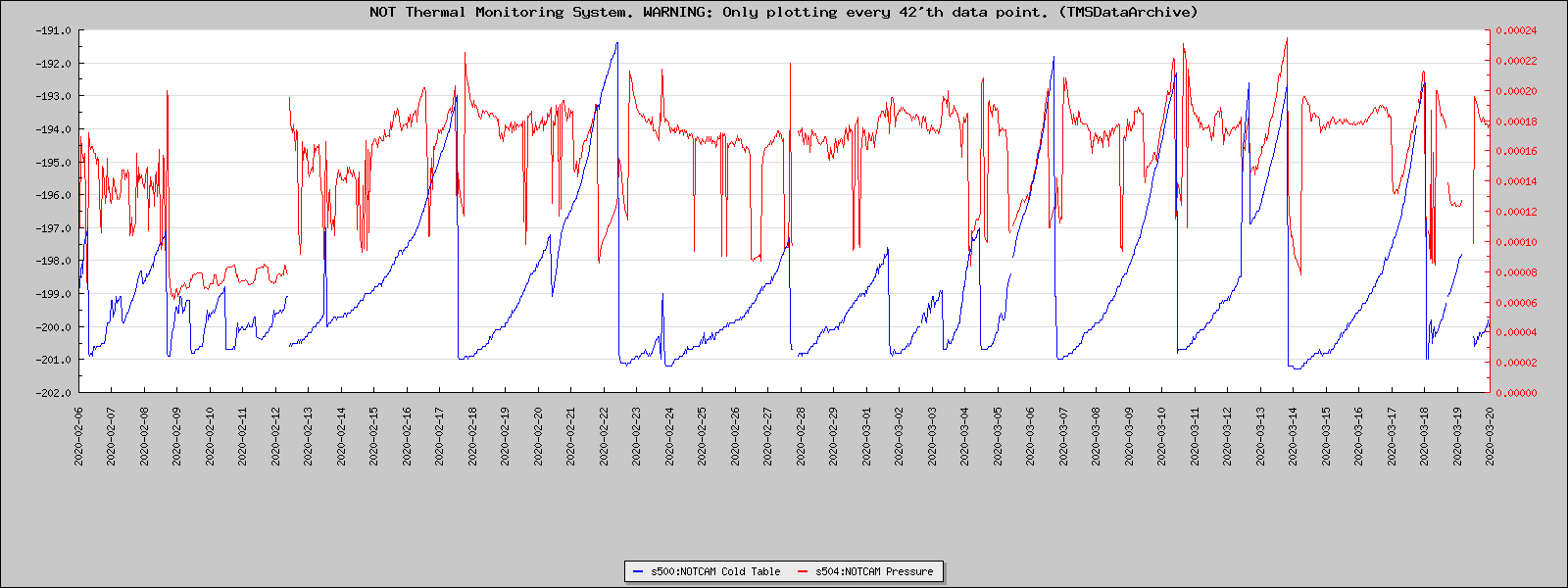
compared to the situation earlier this year:
TMS plot Feb 6th - Mar 20th
where the pressure was typically 2E-04 mbar and the cold table temperature
was never stable.
|
| 2020-01-12 |
Less frequent LN2 fillings |
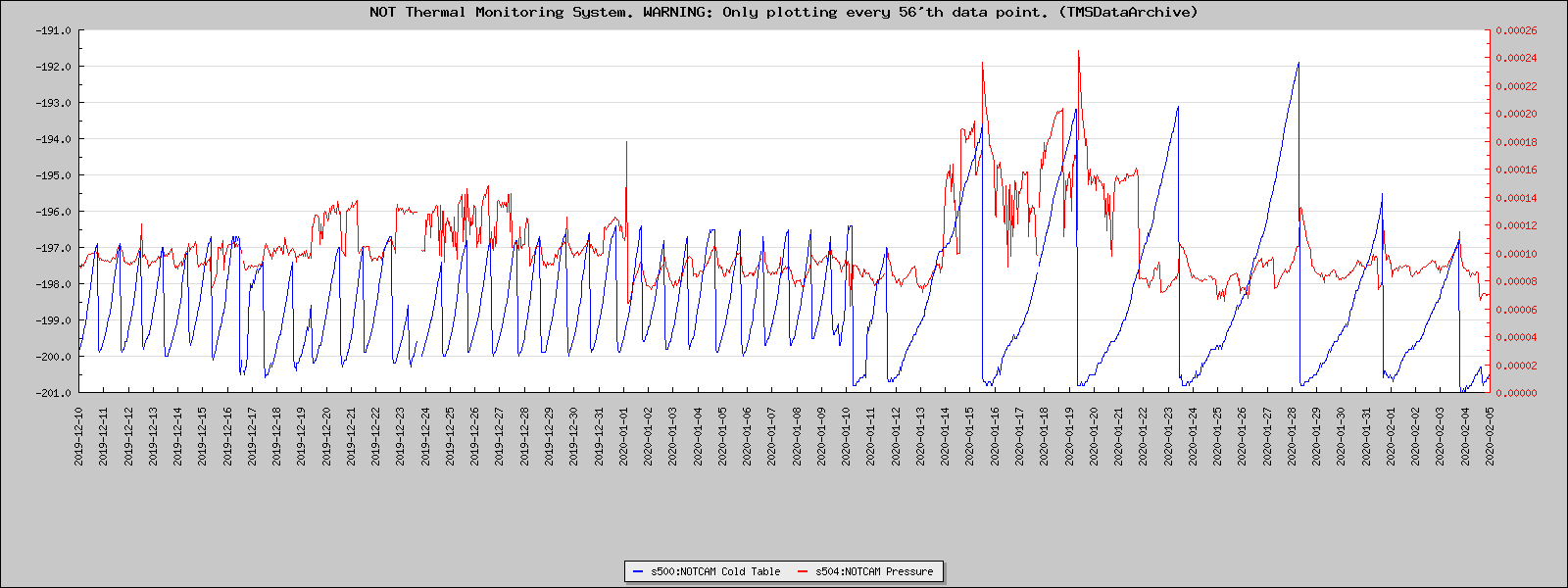
The limiting temperature for re-filling with LN2 was relaxed to -192 deg
allowing for less frequent fillings and better behaviour of the cryostate,
which can be seen in this plot covering before and after the change:
TMS plot Dec 10 - Feb 05.
The history behind the frequent fillings was that of a maximum precaution
against a potential inaccessability of the observatory, to avoid NOTCam
warming up. Some years ago we had set a strict limit (-196 deg) for the
detector temperature for when to alert staff to fill NOTCam. It was,
however, over years realized that the LN2 tank absorbs water, which forms
ice, causing problems with LN2 filling, only small mounts could be fitted
in the tank, and eventually needing a warm-up and opening. In Jan 2020 we
decided to relax on the refillings and let it warm up much more before a
new filling was made. This improved the cryostate behaviour.
|
| 2019-07-22 |
Warm-up on pump |
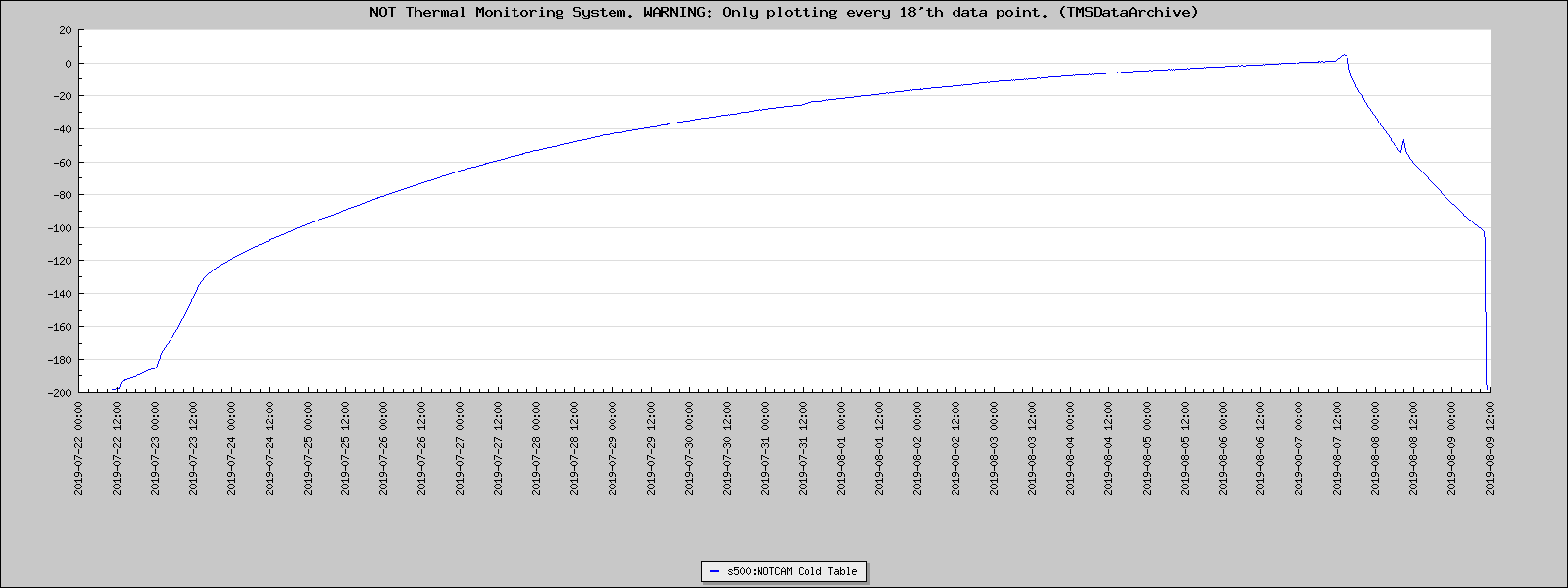
NOTCam was set to warm-up while being connected to the vacuum pump on
July 22nd. The aim was to improve the holding time by pumping the
LN2 tank which is suspected to have water ice accumulated in it. This
is a similar procedure as the one done in May 2013 for the first time.
See Cold table TMS plot.
The PTR was started again on Aug 7th and LN2 filling started Aug 9th.
Due to outgassing the pressure sensor got saturated and stopped showing
reliable results. The pressure measured on the pump before filling with
LN2 was 5.2E-6 mbar. At the next NOTCam opening the pressure sensor
will be cleaned.
|
| 2018-10-30 |
Vacuum improvement |
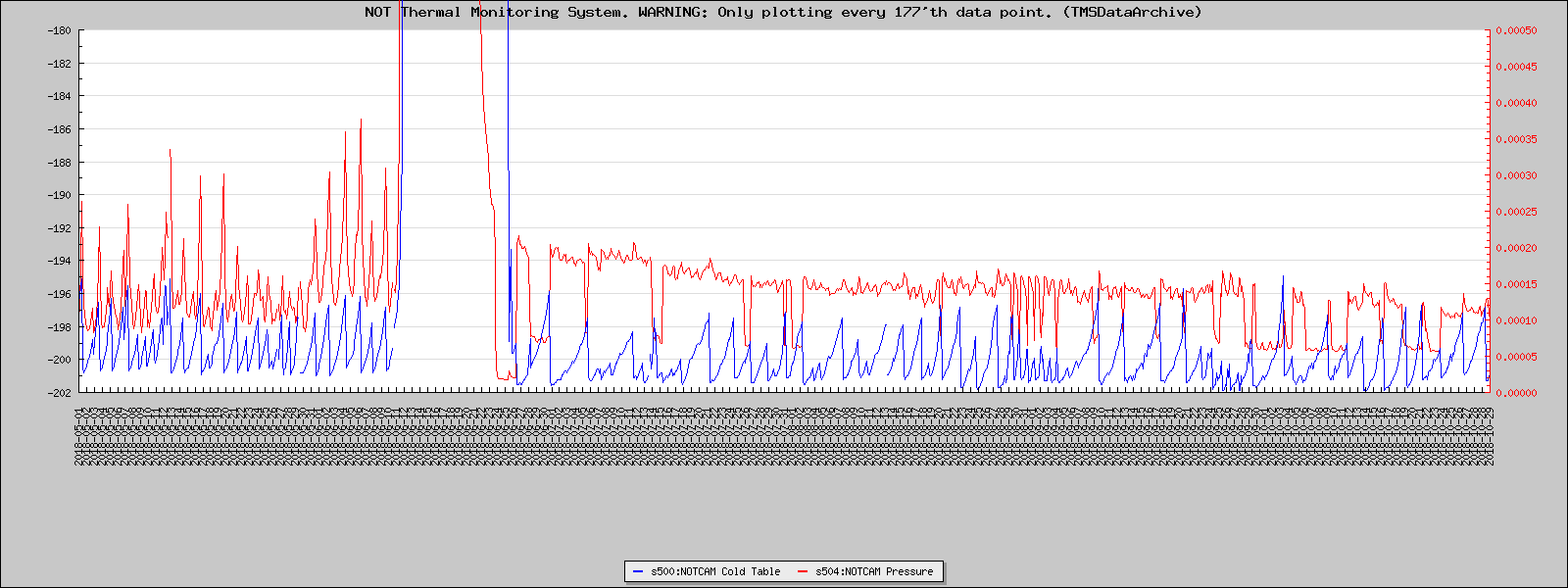
Monitoring of the pressure inside NOTCam shows that the stability of the
vacuum improved substantially after the maintenance performed during the
last opening of NOTCam in June 2018. See
TMS plot May-Oct 2018
of the pressure and the cold table temperature.
|
| 2018-06-11 |
NOTCam Opening
11 - 26 June 2018 |
NOTCam was set to warm-up on the morning of June 11th after observations,
transported to the SB the same day, and was sufficiently warm to be opened
on the 15th. The DKDP was dismounted and stored in a dry environment. The
getter was set to baking. The interior was investigated for dust and wear.
The LN2 tank was pumped with the roughing pump to suck out accumulated
water. Pressure sensor cleaned. NOTCam was closed on the 18th and set to
pump. Transport to the telescope on the 20th, PTR switched on 23rd and
filled with LN2 on the 25th. Total time from warm-up to cold again estimated
to about 14 days.
|
| 2018-02-19 |
New DKDP test
|
The DKDP currently mounted in NOTCam still shows the same structure as when first
mounted two years ago. This means that it is either not due to ice condensation,
or that water does not easily leave the KDP.
|
| 2017-05-04 |
PTR oil adsorber
|
As part of the Iwatani PTR maintenance, the oil adsorber for the compressor
(model CW303) should be exchanged every 15000 running hours. From experience
we have run safely about 30000 hours earlier. At 52000 hours we now contacted
Kelvin International in order to refurbish this piece. The new one arrived and
was installed on June 12th. The old one sent back to KIC.
|
| 2017-04-04 |
Spectroscopy scripts
|
Dithering along the slit in spectroscopic mode has been upgraded from the
standard ABBA mode of 4 spectra to the new
AB3 mode , which is taking 6 spectra in the sequence ABABAB. This mode
allows for better background subtraction and allows one to discard the first
exposure (which is useless due to the reset anomaly) with less total loss.
For extended object spectroscopy the script notcam.ab3-beamswitch
can be used. It is similar to AB3, but starts with an offset to the B position
(such that the off-target spectrum is the one to discard) and allows for small
step dithering to filter out bad pixels. For an overview of the
spectroscopy scripts, see
NOTCam spectroscopy scripts.
|
| 2017-03-02 |
OB generator
|
The Observing Block
Generator is now offered for NOTCam, with the OB compiler fully
functional for the imaging mode. From a user's point of view, the OB generator
is also offered for spectroscopy. Because the compiler is still pending for
this mode, the observer will run a set of template scripts in a semi-automatic
mode.
|
| 2017-02-02 |
FITS header updates
|
The new NOTCam FITS header keyword IMAGECAT is introduced and set in
various NOTCam template observing scripts (resetting to default value
SCIENCE upon ending). The definition of FITS header keywords follow the
Description of FITS headers at the NOT (2014)
(PDF document).
|
| 2016-09-30 |
Better vacuum |
The cryostat vacuum is a factor of two better than what we have had
over the last years. We believe this is due to the teflon-jacketed
o-rings installed in the fill/vent tubes in March-2016. There seem to
be no more problems with vacuum losses every time we fill with LN2.
|
| 2016-05-22 |
New fiber needed.
|
The optical fiber that goes from the detector controller sequencer board,
mounted on the instrument, to the instrument computer in the electronics
room was found to cause stress on the sequencer board connectors, and a
replacement fiber has been ordered.
|
| 2016-04-22 |
Zero pixels on all quadrants.
|
A sudden and fatal error while observing. From one image to the next all
pixels became zero valued. Trouble shooting the controller and exchanging
boards fixed the problem. With this also the elevated readnoise on the
upper two quadrants seemed to come down to nominal values.
|
| 2016-03-18 |
New LN2 filling system.
|
A completely new LN2 filling procedure was setup in order to avoid poking with
the filling hose inside the fill tube and making damage to the interal tube.
The tube seemed to have become loose on the inside. Now the filling hose from
the LN2 bottle is attached with a clamp on the outside. Apart from saving the
inner tube from more damage, the new system seems to improve the problem with
dripping.
|
| 2016-03-15 |
Slow cooling down |
NOTCam was cooled down all the way to -180 degrees only by the aid of the
PTR. This gradual cool-down took a much longer time, but was made to see if
the KDPs acted differently, and also to find out at what
temperature the KDP crystal would become structured. It was also expected
that having NOTCam already cooled, could cause less harm to the fill/vent
o-rings when finally filling the LN2, but this made no difference.
|
| 2016-03-10 |
The funny KDPs!
|
Two KDPs were tested in NOTCam cold. The crystals looked broken when cold,
but both regained their transparent and smooth surface when warmed up
again.
Internal KDP test report.
|
| 2016-03-08 |
NOTCam Opening
25 Feb - 22 Mar 2016 |
NOTCam was set to warm up on February 25th. New O-rings for the LN2 tank fill/vent
tubes had been ordered and arrived just in time for installation. NOTCam was then
transported to the service building clean room on March 7th and opened. The KDPs
were dismounted and put in a dry environment. The getter was set to baking.
Filter-wheel 1 was examined and a not-well-solded motor cable was identified and
fixed. One KDP was put back for further testing inside NOTCam. NOTCam was closed
and set to pumping March 8th. Transported to the dome on March 14th, PTR switched
on March 15th for a slow cool-down, and filled with LN2 on March 21st.
|
| 2016-01-15 |
NOTCam Opening
23 Dec - 22 Jan 2016 |
NOTCam was set to warm up on December 23rd. Transported to the service building
clean room on January 11th. The pressure sensor was cleaned, the getter set to
baking, and all gear-wheel bearings and flexible couplings checked carefully.
On January 15th the spare J-band filter, mounted in the stop wheel, was taken
out to be sent for a proper leak measurement. Two test blockers, one KDP and one
DKDP, were installed in the small slots in the aperture wheel. They were exposed
to a relative humidity of about 32% in the clean-room for about 1 hour before
NOTCam was closed and set to pumping on Jan 15th, transported to the dome on
Jan 18th, PTR on Jan 20th and ready cold on Jan 22nd.
|
| 2016-01-15 |
The KDPs arrived!
|
In the very last moment before closing NOTCam, the KDPs arrived to La Palma.
|
| 2015-11-01 |
Two years cold!
|
NOTCam has been two years continuously running without an opening. This is a new
record. The vacuum starts to deteriorate slightly, however, so we plan for an
opening relatively soon to bake the charcoal getter and vacuum pump it warm.
|
| 2015-06-01 |
One quadrant failed
|
The upper left quadrant was not responding during the observations on
June 1st. Fixed before the following NOTCam run.
|
| 2015-05-29 |
New Argon lamp power supply installed
|
The new Oriel 6046 power supply for the Argon lamp arrived and was
installed and tested.
|
| 2015-02-04 |
New PTR hose installed
|
The 2nd new PTR hose of ultra-flex type arrived on December 12th and was
connected to NOTCam on February 4th. From now on we are running with two
hoses of the same ultra-flex type. The old hoses are spares.
|
| 2015-01-28 |
Oriol Argon lamp power supply ordered
|
It was realized that the reason for the Argon lamp switch-on delay could
be in the power supply we use. Thanks to kind help from the TNG, it was
found that our Argon lamp works well with their power supply. Therefore
we decided to order a new power supply of model Oriol 6046 (plus spare).
|
| 2014-12-03 |
IRAF package notcam.cl upgraded to v2.6
|
The notcam.cl (quicklook) reduction package for NOTCam imaging has been
upgraded to v2.6. This mainly involves including rejection masks to better handle
the noise properties in the combined image where the number of overlaps differ,
plus some bug fixes.
Download and
installation info.
|
| 2014-11-07 |
Z and Y band spectroscopy in ETC
|
The ETC was updated (v2.4) to include NOTCam spectroscopy in the
Z (0.830-0.927 micron) and Y (0.978-1.081 micron) bands . The numbers are
based on
measured throughput from 2011 using the star SP2209+178 and the 1mm large
pinhole.
|
| 2014-09-29 |
New script: notcam.acquisition
|
There is now a slit acquisition script available for NOTCam to speed up
NIR spectroscopy. The script notcam.acquisition can be used for both
WF-cam (R~2500) and HR-cam (R~5500) spectroscopy and is similar to the
alfosc.acquisition script, but with a few additions. Due to flexure, an
image of the slit is taken at every pointing and the position of the slit
measured every time. Also, sky-subtraction of the acquisition image is
available, if needed, when the source is fainter than the background.
|
| 2014-09-23 |
Helium hose leakage
|
Yet another helium leak in the old hose of the PTR cooling system. The
hose was exchanged with the spare and the broken hose welded, tested,
and pressurized. The location of the leak was again close to the
instrument end.
|
| 2014-09-22 |
Temperature control board changed
|
A malfunctioning temperature control board in NOTCam
was exchanged with the spare. The broken board will be repaired.
|
| 2014-09-04 |
Rotator limit check in scripts
|
The NOTCam template scripts notcam.9point, notcam.5point,
notcam.beamswitch, and notcam.abba (see NOTCam scripts) have been upgraded to
include a check on the time to reach rotator limit. We use maximum overheads
estimate to calculate how long the scripts will take to execute. If this time
is shorter than the time for the rotator to reach limit, the scripts will abort
with an error message
"[ERROR]: Rotator will reach limit before script ends. Aborts!"
. The user should modify script parameters to lower execution time or
turn the rotator by 360 degrees.
|
| 2014-08-28 |
New PTR hose ordered
|
We have ordered another 12.5 m long 20 mm diameter stainless steel braid
over flexible (ultra-flex) helium hose from Kelvin International. It will
be delivered with 99.9995% (UHP) Helium.
|
| 2014-08-19 |
Another helium hose leakage
|
Another helium leak in the old hose of the PTR cooling system. The
hose was exchanged with the other old spare. The broken hose fixed,
tested, and pressurized. The location of the leak was again close
to the instrument end. The old hoses apparently break more frequently.
|
| 2014-04-14 |
PTR helium hose leakage
|
A major helium leakage in the hoses of the PTR cooling system was noted 9/4
and verified 11/4. On 14/4 the location of the leak was found to be in the
old hose (the one used for the return flow), and it was then exchanged with
the spare hose (the other old hose). The broken hose will be repaired and
kept as a spare. NOTCam was kept cold all the time, though on LN2 only over
the few days before the bad helium hose was exchanged with the spare.
|
| 2014-02-17 |
Internal focus with wavelength
|
Measurements of fwhm offsets at both wavelength extremes for the
potential use of one fixed internal focus setting, shows that this is fully
doable. A fixed setting would be needed for low resolution
spectroscopy modes covering the whole range from 0.8 to 2.4 microns.
|
| 2013-11-04 |
New PTR hose installed
|
The new PTR hose was connected as a replacement for the most repaired
hose (supply hose). The new hose is more flexible than the old ones.
|
| 2013-10-24 |
NOTCam Opening
21 Oct - 12 Nov 2013 |
NOTCam was set to warm up on October 21st. Detector temperature reached
+7 deg after 3 days. Transported to the service building clean room on
October 24th. Operations: cleaning pressure
sensor, exchanging fill/vent tube o-rings, wet cleaning of entrance window,
installing WF-camera imaging mask in the aperture wheel (taking out the
64 micron slit), installing replacement KG2 filter for out-of-spec KG4.
NOTCam was reassembled and closed on October 28th and pumping started.
Transported to the dome on the 31st, pumping continues. After one week
of pumping the pressure is 2E-04 mbar at a temperature of 15 degrees.
PTR switched on on Nov 8th, LN2 filled on Nov 11th.
|
| 2013-10-10 |
Illumination correction |
A section describing the WF-camera illumination correction has been
added to the NOTCam Calibration page . There is a model available for
the H-band, kindly made by Janz, Laurikainen, Lisker et al. 2013 who obtained
the needed mapping of the field-of-view for the H-band in photometric hours
during their own observing time. Mapping of the J and Ks bands is still
pending.
|
| 2013-09-14 |
New calibration script
notcam-calibs |
At the end of an observing night, when the dome is closed and
dark, you can start the script notcam.notcam-calibs [date-string] to
automatically take 10 darks of each of the used exposure modes during the
night. See more info under NOTCam scripts.
|
| 2013-05-27 |
NOTCam warm-up and pump |
NOTCam was warmed up in the dome on May the 27th, being
all the time on the pump. The LN2 tank was dried by blowing dry nitrogen gas
trough it (gas from our LN2 flasks heated up with a bulb) and then pumped.
NOTCam was cooled down again on June the 6th. We achieved a relatively good
vacuum of NOTCam of 1E-05 mbar when starting to cool it with the PTR only.
At a temperature of -80 degrees we started to fill with LN2 and the pumping
was disconnected. The good vacuum was by this action lost to the more
typical 2E-04 mbar, pointing again to thermal stresses at the fill tube
O-rings. On the next opening these should be exchanged and we should
increase the heating around these when filling. The behaviour of NOTCam is
currently pretty much like it was before this exercise, but it is an
important lesson that we actually can go for a warm-up without the need to
open and bake the getter, a less risky procedure with less work.
|
| 2013-04-29 |
NOTCam reset-level monitoring |
The reset level (i.e. the ADU level of the pre-integration
readout) is supposed to be a smooth function of detector temperature. At
commissioning the DC-offset voltages were adjusted such that the level is
6000 ADU at operating temperature, a level that maximizes the dynamical
range and minimizes bad pixels. Over time we have experienced jumps in
this level, frequently so large that readjusting the DC-offset voltages
is necessary. The first monitoring of the level (at every hour when
NOTCam is off the telescope) started in June 2012. Because of the 1GB of
data generated every day, the monitoring script was upgraded to analyse
the images on-the-fly and delete them immediately. Monitoring re-started.
|
| 2013-04-20 |
NOTCam spare PTR hose arrived |
A 12m long 20mm diameter spare helium hose for the NOTCam
PTR arrived from Kelvin International.
|
| 2013-02-01 |
Exposure time checking |
On rare occasions controller glitches have given exptimes
shorter than requested. An "exptime-checker" program has been made to check
every file automatically from now. An error message is displayed on the
Talker messaging system if a problem is found.
|
| 2013-01-25 |
PTR - cooling water maintenance |
We had repeated problems over weeks in adjusting the
PTR cooling water temperature. It was found that the PTR cooling water
was dirty, so the whole secondary water circuit was properly cleaned.
Also, the purg-o-matic valve has been exchanged for a new.
|
| 2013-01-22 |
Large reset level jump |
The dc-offset voltages had to be adjusted for the two
lower quadrants, as the reset level had jumped from 6000 to 2000 adu.
The reason for this is unknown.
|
| 2012-10-24 |
PTR hoses He leak fixed |
Again a Helium leak was detected in the PTR system. The
leak originated in a crack in the flexible part of the supply hose,
close to the instrument end, again near the previous point of repair,
in a very vulnerable location where hoses are bent during operation.
The tube was cut, re-welded, vacuum pumped and refilled with Helium.
|
| 2012-10-03 |
Upgrade of notcam.cl to v2.5 |
The IRAF quicklook reduction package notcam.cl has been upgraded to v2.5
in order to be able to handle both the old and the new fits header
keywords. See
download and installation info and NOTCam User's Guide -
Data reductions for details.
Note that you need this new version to work on data taken
after October 1st 2012!
|
| 2012-10-01 |
New fits header keywords |
Several NOTCam fitsheader keywords have changed name. This includes
the old keywords APERTUR, FILT1, FILT1ID, FILT1POS, FILT2, FILT2ID,
FILT2POS, STOP, GRISM, LENS, CAMERA that are now called NCAPRNM,
NCFLTNM1, NCFLTID1, NCFLTPO1, NCFLTNM2, NCFLTID2, NCFLTPO2, NCSTPNM,
NCGRNM, NCCAMNM, NCFOCUS . All related software has been updated
and tested. Also, from now on we use editsetup to change the
NOTCam instrument setup, and the old wheel definition files are
obsolete.
|
| 2012-07-01 |
A new KG4 filter |
A new filter replacing the out-of-spec KG4 arrived from the provider
at no cost. Installation is pending.
|
| 2012-06-20 |
New controller - User requirements |
The 34 page document User Requirements for the new Controller and Data
Acquisition System for NOTCam (PDF file) was presented to the controller
development group at CUO (Copenhagen University Observatory).
|
| 2012-06-14 |
Easy spectroscopy calibration |
The new script notcam.easy-calib is offered to make the
in-situ spectroscopy calibration with NOTCam easier. Since this must
be done at night and involves closing the mirror covers, the script
easy-calib fid1 [fid2] [fid3] [fid4] [fid5] allows one to do
1-5 wavelength regions in one go. The script takes 1 Argon, 1 Xenon,
and 3 Halogen lamp images per wavelength region (indicated with the
FILTER ID number of the broad-band filters used as order sorters),
each using the default exposure times. Calculate 2 minutes per region
plus 1.5 minutes for mirror-cover closing and opening. The script
uses notcam.setup-spec and notcam.calibexp. See more
info under NOTCam scripts.
|
| 2012-04-20 |
Spectroscopic throughput in Z and Y |
Flux standards observed through the pinhole were used to derive the
efficiency in spectroscopic mode of the new wavelength ranges available
and defined by the broad band
Z (0.830 - 0.927 microns) and
Y (0.978 - 1.081 microns) filters. Adding up the two partly
overlapping orders, the efficiencies are ~ 7% in Z and ~ 9% in Y, compared
to ~ 10% in J. Remeasuring the single-order efficiencies of H and K gave
7% and 6%, respectively. To be verified with new observations.
|
| 2012-04-01 |
The BK7 and KG4 filters |
Calibrating the KG4 and BK7 glass filters that were installed in filter
wheel 1 in order to be used in combination with the Z-filter to improve
the red leak problem. BK7 reduces the thermal leak by merely 25%,
while it also reduces the throughput in the Z-band by almost 10%.
KG4 reduces the thermal leak by 90%, but it was found that its throughput
in the Z-band was much lower than specification, and the provider was
contacted.
|
| 2012-03-14 |
NOTCam Opening
14-15 March 2012 to install filters |
A planned opening took place for the installation of filters: the
two glass filters BK7 and KG4. The charcoal getter was baked for 24 hours,
as usual. The opportunity was taken to bake the whole instrument at 37
degrees for 8 days. The LN2 tank was pumped as an attempt to diminish the
suspected water content.
|
| 2012-03-04 |
PTR hoses He leak fixed |
A Helium leak was detected in the PTR system. The
leak originated in a crack in the flexible part of the supply hose,
close to the instrument end, near the previous point of repair, in
a very vulnerable location where hoses are bent during operation.
The tube was cut 10 cm, re-welded, vacuum pumped and refilled with
Helium.
|
| 2012-01-17 |
Upgrade of notcam.cl to v2.4 |
The IRAF package notcam.cl for quick-look reductions of
NOTCam imaging has been upgraded to v2.4. This version includes
optional distortion correction in the tasks reduce and
reduce_bs. A task mklincor for pixel-by-pixel
correction of the non-linearity was added. The package is NOT a
pipeline and was intended for quicklook reductions. See
download and installation info and NOTCam User's Guide -
Data reductions for details.
|
| 2012-01-12 |
WF-cam distortion model |
A model for the WF-cam optical distortion for the J, H and Ks
filters based on high-quality data from 2009 is available in the
form of IRAF transformation records to be used with geotran to
correct the images. See
NOTCam Calibrations for details. Optional correction is included
in the NOTCam Quick-Look reduction package (notcam.cl v2.4).
|
| 2011-11-30 |
Details on observing overheads |
Results from detailed investigations of the observing overheads
can be found in NOTCam User's Guide - Overheads.
|
| 2011-10-12 |
Speeding up dithering
|
For the expose command the telescope dither can now be
performed as soon as the shutter has closed (using the new
command notcam.wait-shutter-closed) i.e. the teloffset
is done while reading out the array and storing the file,
interlacing these overheads and increasing the speed of
observing. This has been implemented for the all the
NOTCam template scripts such as notcam.skyflat,
notcam.5point, notcam.9point, and
notcam.beamswitch, and it will be implemented in the
NOTCam script generator. Timing measurements show that we now
save on the average ~ 5.6 seconds per exposure in a dither
sequence. The total time spent on a dither pattern is
T_now/T_before = 0.76 for exp 3 and 0.82 for exp 10.
|
| 2011-07-01 |
PTR compressor oil filter replaced |
PTR maintenance: the compressor oil filter was exchanged with a
new refurbished unit from Iwatani after a run time of 63199 - 28316 =
34883 hours.
|
| 2011-06-10 |
Z-band leak down
|
The leak around the transparent edges of the Z-band filter was
stopped by flipping the filter around in the holder and adding
a cold stop ring to it. In total, there is now less background
in the Z-band filter (the Z/Ks background ratio went from 1.2
to 0.88). As those numbers show, however, there is still a
significant IR leak through the filter, and mainly beyond 2.5
microns, and we are currently asking quotes for a suitable
blocking filter to mount in the other filter wheel. See updates
in the
ZY filter commissioning report.
|
| 2011-05-15 |
NOTCam Opening 24-31 May 2011 due to
Filter-wheel-2 failure
|
It was realized that filter wheel 2 started to fail on positions as
described in Fault
report 1514.
No definite diagnosis could be made, and it was decided to warm up
NOTCam for an opening (19/5). NOTCam was transported to the SB on
the 24th and opened on the same day. It was found that the flexible
coupling between the motor and the worm gear was broken. The reason
for this remains unclear. Not only filterwheel 2, but all wheels
therefore got their couplings exchanged with new ones. Also, all
the gear wheel bearings were
exchanged after 3.5 years use, as part of our maintenance plan. The
Balzer pressure sensor was cleaned. We took the opportunity to flip
around the Z-filter and put a cold stop on top of it. Instrument
cleaned inside, charcoal baked, and NOTCam closed and set to pumping
31/5.
|
| 2011-03-18 |
NOTCam Cookbook (new format).
|
As part of the new instrument specific NOT Cookbooks
in general, the new format NOTCam Cookbook was added and thereby replaces
the old
NOTCam step-by-step manual for observers, which is now obsolete.
Included in the new NOTCam Cookbook is also the preparing
NOTCam observations page, a link which now becomes obsolete and will be
removed. The NOTCam Cookbook printed version is found in an orange booklet
in the control room.
|
| 2011-02-19 |
New Z and Y filters!
|
The new broad band filters:
Z (0.830 - 0.927 micron) and
Y (0.978 - 1.081 micron) were commissioned (see report).
|
| 2011-02-12 |
New filter focus offsets.
|
In conditions of good seeing, the opportunity was made after having had NOTCam
open and disassembled, where special care was taken to align the detector
plate when re-assembling, to re-measure the focus offsets between cameras
and filters. The focusing procedure was found to converge quicker than it
used to, and the scatter over the fov is smaller, probably owing to the
better aligned detector and the re-calibration of the pyramid in late 2010.
The new focus offsets are implemented in the instrument setup scripts
notcam.setup-ima and notcam.setup-spec.
|
| 2011-02-12 |
Reduced overheads.
|
Some internal overheads that had increased over the years have been taken
care of. Both the Talker Log and the Obslog are now running
on another computer, and we are back to nominal overheads for NOTCam data
acquisition. See Overheads at
the NOT and more details in the
NOTCam User's Guide.
|
| 2011-01-11 |
NOTCam Opening 11-13 Jan 2011
|
NOTCam was opened on 11/1-11 for the installation of two newly acquired
broad band filters: Z (0.830 - 0.927 micron) and Y (0.978 - 1.081 micron),
see updated
NOTCam filter list.
The instrument was cleaned for dust, the 44 micron slit was aligned
and fixed, a new PROM with modified code for the focus mechanism was
installed and tested, the gear wheel bearings were checked, and the
movement of filter wheel 1 was made smoother. The detector plate was
well aligned with respect to the camera wheel housing when
re-assembling the instrument. NOTCam was closed and put on the vacuum
pump on the 13/1 with newly baked charcoal inside.
A baking at <= 40 degrees of the whole cryostat was started thereafter.
Functionality of detector and all wheels checked.
|
| 2010-11-18 |
QC analysis script upgraded
|
The Detector Quality Control
for NOTCam was upgraded. The analysis script was rewritten from IDL to
python and some improvements and additions were made.
|
| 2010-10-28 |
Baffle calibration lamps online
|
The NOTCam spectroscopy calibration unit, the three lamps (Halogen, Argon,
and Xenon) mounted on the inside of the baffle lid, are now on-line and can
be controlled from the TCS and the Sequencer. Their status goes to the
NOTCam FITS headers. The script notcam.calibexp
sets up the telescope for baffle lamp exposures, an action which involves
switching the TV off (for protection) and closing the mirror covers, and
takes the requested exposures with the selected lamp. Usage is documented
in the
NOTCam Cookbook.
|
| 2010-09-29 |
Pointing Scripts
|
Use the new
Pointing Script Generator to prepare scripts for NOTCam
targets. This speeds up target acquisition and is particularly useful if
you do larger than 60'' dither steps, which is typically the case for
beam-switching, and/or if you wish to have the target oriented differently
than the default for NOTCam. Both field orientation and guide area is taken
care of by the script and you save time at the telescope.
|
| 2010-09-27 |
Non-linearity correction
|
Pixel-by-pixel coefficient images are available for the correction of
the inherent non-linearity of the NOTCam detector. The correction must be
applied to the raw data as a first step in the data analysis. For more
information see the page
NOTCam Calibrations.
|
| 2010-08-20 |
Filters in the parallel beam
|
A note was added to the
NOTCam Filters page about the shift in wavelength of the transmission
curve across the field of the detector for a filter mounted in the parallel
beam.
|
| 2010-06-18 |
Leaking PTR hoses fixed
|
The PTR hoses had suffered a longer time from a minor leak, implying refilling
with Helium gas about once per month, but suddenly the problem deteriorated and
needed repair. The leakage was located to be close to the instrument end, and
the problem was fixed by cutting the hoses shorter. The NOTCam mounting
instructions were modified to make sure the hoses are properly treated when
mounting/dismounting NOTCam.
|
| 2010-05-27 |
Upgrade of notcam.cl to v2.3.
|
The NOTCam quick-look reduction IRAF package on Florence has been upgraded to
v2.3. The same for SLO computers. See the
NOTCam User's Guide - Reduction section for documentation.
|
| 2010-05-25 |
Remotely controlled QC lamp
|
The new remotely controlled lamp for NOTCam Quality Control, domeflats, and various tests has been
commissioned and calibrated, and all documentation has been updated.
|
| 2010-05-09 |
One year cold!
|
NOTCam has been kept at operating temperature (-199 degrees) for one year with
no incidents.
|
| 2010-02-27 |
NOTCam instrument setup scripts.
| The instrument setup script for imaging mode notcam.setup-ima
has been upgraded to include the focus offsets (i.e. tcs.focus-delta)
corresponding to the filter and camera selected. NB! Note that the script
assumes you have put the telescope focus for the WF camera and the Ks band as
the tcs.focus-position value, which is also the default focus for NOTCam.
There is a new instrument setup script for spectroscopy:
notcam.setup-spec. Both scripts are described on the page NOTCam
Sequencer Scripts.
|
| 2010-02-06 |
Focus pyramid re-calibrated.
| The focus pyramid for NOTCam, first installed and calibrated in 2005,
was re-calibrated for both cameras with through-focus data taken in good
seeing conditions in September 2009. Using the newly calibrated pyramid,
the focus offset between the WF and the HR camera is now found to be +136
units (compared to earlier +90).
|
| 2010-01-14 |
New clock boards.
|
The new clock-boards for the NOTCam controller were installed and tested.
The old boards had clock voltage levels only ~3.5V while the new ones give
5V, according to specifications. This removed completely the shift register
glow and provided much nicer images in low background mode (darks, spectra etc).
See more info in
NOTCam new clockboards. Also, the measured readnoise for the reset-read-read
mode is both lower (8 electrons) and more stable, see the
Detector
Quality Control results.
|
| 2009-10-07 |
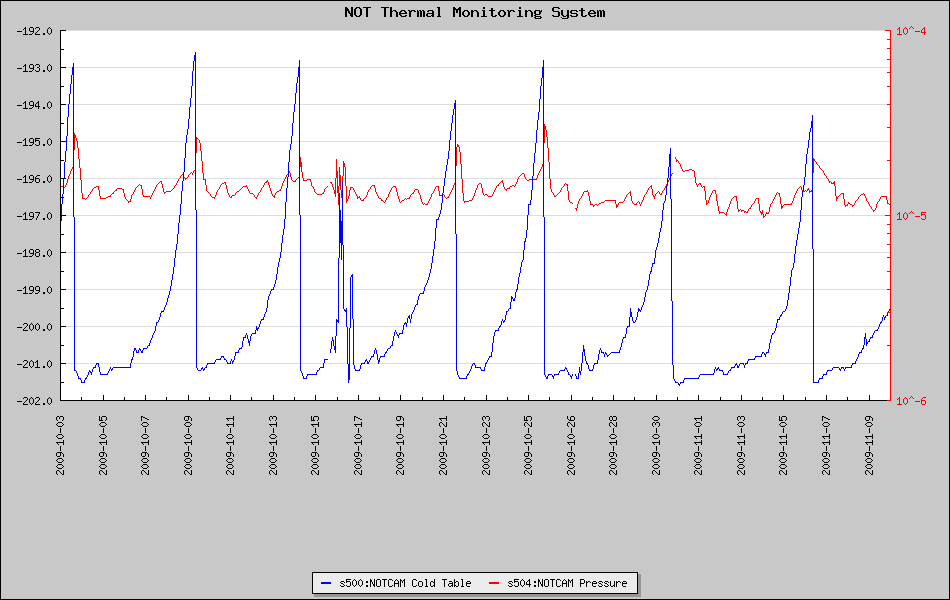
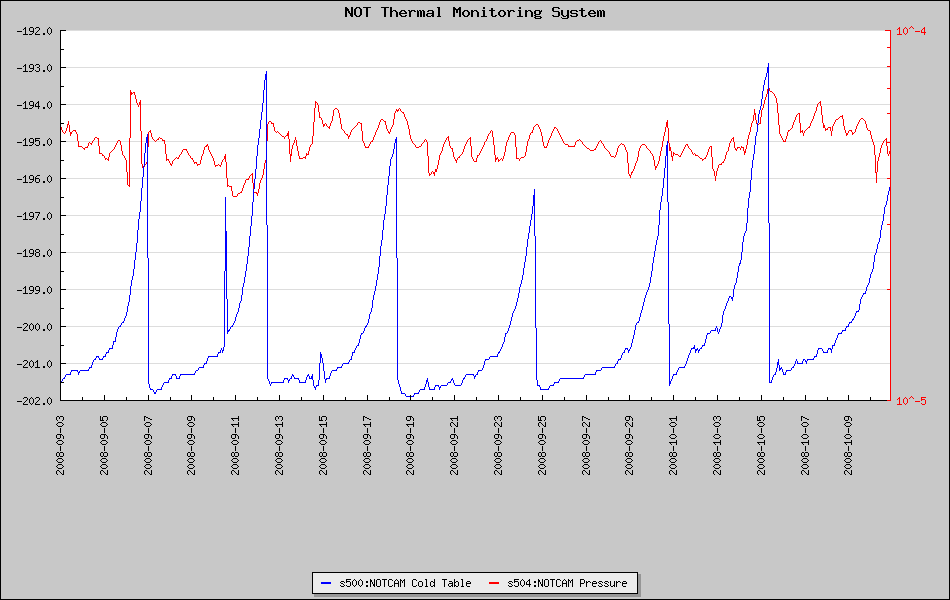
New LN2 filling nozzle |
The new LN2 filling nozzle, designed and made by Pedro out of a highly
insulating special plastic material (same as used for the fill tube "cork"),
was taken in use on the 20th of May. The vacuum five months after cool-down
of NOTCam is on the average 1E-05 mbar (see newplot).
One year ago using the old filling nozzle the average vacuum five months after
cool-down was 5E-05 mbar (see oldplot).
|
| 2009-09-28 |
Improved guiding for large teloffsets |
New NOTCam guide areas for beam-switching were defined as NOTCAM-S-posX,
NOTCAM-N-negX, NOTCAM-E-negY, and NOTCAM-W-posY, where the
S, N, E, W sky directions for moving the telescope are valid only for default
field rotation (-90), whereas the pos/neg XY directions for moving the star(!)
on the array are always valid. Documented in the
NOTCam Cookbook. The improvement from the earlier version from
2008 is basically larger areas and higher chances of finding a guide star, as
well as easier use. The
beam-switch
observing script uses the same terminology.
|
| 2009-06-11 |
NOTCam remote observing
|
NOTCam has been used in remote mode for the first time during the three
nights 9/6 to 11/6 2009 by the Nordic-Baltic Optical/NIR and Radio Astronomy
Summer School on "Star Formation in the Milky Way and Nearby Galaxies" held
at Tuorla Observatory, Turku, Finland. The observations were successful,
and all student groups got their about 2 hour observing slot with NOTCam each.
|
| 2009-05-28 |
Upgrade of some
NOTCam
SEQUENCER scripts |
The NOTCam sequencer observing scripts notcam.5point,
notcam.9point, and notcam.beamswitch have been upgraded to
higher flexibility. The user can select exposure mode (exp, mexp, frames),
dither step size, an additional offset to allow for skewed grids (to avoid
a fixed grid pattern and repeated positioning on the dead column), and there
is an option to repeat the dither pattern a number of times. For the
beam-switching mode the additional features are: selection of beam offset
and direction on the sky.
|
| 2009-05-26 |
Upgrade of notcam.cl to v2.2. |
The NOTCam quick-look reduction IRAF package on Florence has been
upgraded to V2.2. The reduction scripts reduce and reduce_bs
now check the FITS header for the date of the observation in order to use
the corresponding exact pixel scale for internal shifts as those applied
by NOT2MEF and thus available in the FITS headers. The script dophot
is made interactive and documented. See the
NOTCam User's Guide - Reduction section for documentation.
|
| 2009-05-18 |
Pixel scale in FITS header |
The actually measured pixel scales for the two NOTCam cameras:
0.234"/pix for the WF camera and 0.078"/pix for the HR camera,
were found to be slightly wrong in the FITS header keywords provided by the
NOT2MEF program. The old values of 0.23"/pix and 0.08"/pix had been used up
to now. NB! The correct pixel scales
were always in use for slitoffset and teloffset calculations.
|
| 2009-04-10 |
NOTCam opening due to accidental
warm-up |
An accidental warm-up after having been cold for 360 days triggered a
complete thermal cycle of NOTCam. After baking the getter, closing and
pumping, while testing the response of the instrument, it was discovered
we had lost contact with quadrant #2. The pre-amplifier daughter board
for this quadrant had broken, and eventually the fault was located to a
transistor mounted inside the vessel on the detector PCB. New pre-amp
boards were received from CUO on May the 3rd. The old one for quadrant
#3 was moved to quadrant #2 and the new daughter board went in for
quadrant #3. The array was taken out and put into a spare PCB. Based on
warm tests we confirmed having contact with all quadrants. It turned out,
however, that quadrant #3 had a funny behaviour realized only with cold
tests. One of the resistors on the board (undocumented) had been given a
wrong value. Replacing this one with the one on the original broken
board solved the problem. NOTCam was ready for use on the 9th of May.
|
| 2009-03-08 |
Upgrade of notcam.cl to v2.1. |
The NOTCam quick-look reduction IRAF package on Florence has been
upgraded to V2.1. The script mkflat.cl now does the bad pixel
correction internally and an extra option is made for suppression of the
bias tilt (or "dc-gradient") caused by the reset anomaly. The scripts
reduce.cl and reduce_bs.cl will work even if there are no
alignment stars available in the images, in these cases using the
"sregister" task which is based on WCS header info, giving a slightly
worse image registration. Trimming of images is set as an option. See
the
NOTCam User's Guide - Reduction section for how to use the notcam.cl
package.
|
| 2009-01-19 |
NIR standard star catalogues |
NIR photometric standard star catalogues can now be directly loaded on
the TCS. These are JHKstd_hunt.cat (Hunt et al. 1998, AJ 115, 2594)
and JHKstd_leggett.cat (Leggett et al. 2006, MNRAS 373, 781). See
NOT
standard star catalogues and for more IR specific info see
IR
astronomy reference info.
|
| 2008-12-12 |
Differential twilight flats |
The stronger reset-anomaly introduced with the upgrade of the array
electronics in Dec-2007 caused problems with the differential flats.
Suppression of the dc-gradient (aka bias tilt) in the difference images
was added as an option in the reduction software. The difference between
using this correction option and not is shown in the
NOTCam User's Guide - Reductions section on master flats.
|
| 2008-09-12 |
Sequencer Scripts and Documentation |
The NOTCam Sequencer Commands are documented in the
NOTCam
SEQUENCER Command Reference, and a set of simple observing scripts
are documented in the NOTCam SEQUENCER Script Reference . These are available from
any directory on the data acquisition computer.
As before, the user can also construct
own scripts through the Observing Script Generator, storing the scripts in the user's
directory on the data acquisition computer, (exceptions are beamswitch mode
and scripts that involve changing filters, as well as more complicated scripts
that can not be handled by the generator yet).
|
| 2008-06-09 |
Safe autoguiding for larger teloffset. |
In order to guarantee safe auto-guiding even for beam-switch
observations, which improves both pointing and image quality, a set
of smaller guide areas was defined for NOTCam. In the case of normal,
small-step dithering (10-15''), the default area works fine, but if
you teloffset larger steps, make sure you use the correct area. For
more details, see the section on Autoguiding in the
NOTCam Cookbook.
|
| 2008-05-22 |
Sequencer Mode |
The NOTCam Sequencer was offered in visitor mode for the first
time on 22/5-2008. The NOTCam
User's Guide and the
NOTCam Cookbook for observers are both updated accordingly. The
Observing Script Generator produces scripts in sequencer format.
|
| 2008-05-02 |
Holding time test |
NOTCam was left without filling for 14 days and the detector
temperature was found to stabilize at -191 degrees (the ambient
temperature being around 11 degrees). This indicates a very good
vacuum, and is, in fact, the best we have obtained. In February
2007 after the improved vacuum behaviour upon cleaning the large
vessel O-ring the detector stabilized at -185 degrees (the ambient
temperature being around 7 deg).
|
| 2008-04-30 |
New Science
Array images |
An RGB coded NOTCam image of the Ring Nebula
(M57) was obtained by combining broad-band J and H images with
narrowband H2 v=1-0 S(1). Beamswitch observations were performed and
the data was reduced using the quick-look reduction tools in the IRAF
package notcam.cl.
|
| 2008-04-18 |
IMAGETYP keyword bug |
Most NOTCam images from 16/4 and 17/4, i.e. NCrd16* and NCrd17* data,
are lacking a correct IMAGETYP keyword. Only the first image in a script
has the IMAGETYP set correctly, and the remaining images have 'blank'
entries. This was corrected 5/5-08, and the sequencer command for giving
the IMAGETYP header (e.g. notcam.imtype FLAT) is again a sticky
command.
|
| 2008-04-02 |
Entrance window crack |
Eventually, it was found that the entrance window had a tiny crack,
and it was replaced by a spare entrance window. After this, the vacuum
performance during warm (+20 deg) pumping of the cryostat was much better
than ever experienced with NOTCam at the NOT, both on short and longer
time-scales (reaching 6E-05 mbar after 2 weeks), see also
pressure plot.
|
| 2008-03-10 |
NOTCam opening
Cryostat
maintenance work |
Trouble shooting and maintenance work on the cryostat was performed
during Feb and March 2008. A leakage test found a problem close to the
entrance window. The entrance window O-ring was therefore suspected and
taken out to be cleaned. In addition, all other O-rings were cleaned: the
large vessel O-ring, the fill/vent tube O-rings, the PTR cold head O-ring,
the O-rings for all the connectors, etc. Also, the pressure sensor was
cleaned. In addition, the whole cryostat was baked to a max temperature
of 40 degrees - twice. First with the cold shield removed, in which case
it was possible to reach only about 30 degrees. Then the cold shield was
re-installed and the cryostat was baked at 37-40 degrees during 10 days.
The vacuum reached was only 1.0E-02 mbar.
|
| 2008-02-12 |
New Science Array JHKs zeropoints |
The New Science Array sensitivity was measured on standard stars on
the commissioning night 13-12-2007. We obtained the following zeropoints
(for 1 e/s): J = 24.11, H = 24.06, and Ks = 23.45 mag, using fixed extinction
coefficients in the fit. Note that the gain is 2.5 e/adu.
The Exposure Time Calculator has been updated.
|
| 2008-01-17 |
IRAF package notcam.cl upgrade to v2.0 |
The IRAF package notcam.cl for quick look reductions, available
on the Florence computer in the control room, has been upgraded to
version 2.0. Any small step dither pattern can now be reduced with
the script reduce.cl, and any beamswitch pattern with the
script reduce_bs.cl. For a description see the
NOTCam User's Guide.
|
| 2008-01-16 |
NOTCam opening
Vacuum
problems |
There is a problem with the vacuum of NOTCam, and we had to
let it warm up by the end of December for a baking of the charcoal
and an examination of the problem. No conclusive results. The next
cool down was done while pumping all the
time, both during the pre-cooling stage with the PTR and during the
LN2 cooling. Disconnecting the pump was fatal, and it was decided to
attach the pump to NOTCam on the telescope while observing for the
coming observing runs in January.
|
| 2007-12-18 |
The PTR rotary valve is back! |
The PTR rotary valve is back from maintenance in Japan and was
today mounted on NOTCam. Performed and cooled as expected.
|
| 2007-12-13 |
New Science Array commissioning (report) |
First cold tests with the new Science Array. Around 1 % bad
pixels, but mainly in one corner. One bad feature. Read noise ~ 10
electrons, gain = 2.5 e/adu. Linear within 1% up to 20000 adu or
more. Saturates at 56000 adu. Flatfield is much flatter than previous
arrays. The general performance of the new array is described in the
document
The New NOTCam Science Grade Array (SWIR3).
|
| 2007-12-07 |
NOTCam opening
New Science Array installed! |
The new Science Array was successfully installed in NOTCam.
Warm tests verified that all quadrants worked well. Again the cool
down was done directly with LN2 because the PTR was unavailable.
|
| 2007-12-03 |
NOTCam opening
Array
electronics upgrade |
The array electronics was upgraded. The bias voltages are set to
recommended values and can also be adjusted. After many warm tests in
the clean room, cold test were made with the engineering grade on
the telescope. The detector quality control data shows that the new
PCB works well in all aspects, but does not cure the dark current
problem. NOTCam had been cooled down directly with LN2 since the PTR
was sent to KIC for maintenance. Due to severe problems with the
vacuum, no observations were made during night time. NOTCam was
emptied of LN2 by putting the telescope to 6.4 degrees altitude and
the rotator position to -65 degrees to prepare for another warm-up
and opening needed to install the new Science Array.
|
| 2007-11-30 |
PTR rotary valve sent to KIC |
The PTR rotary valve was sent to KIC for maintenance. While it is
gone we rely solely on LN2 for cooling.
|
| 2007-11-24 |
Exchange of bearings |
As a preventive means, all worm wheel bearings are exchanged with
new ones every two years. This time all the old ones were found in a
perfect state, but were still exchanged.
|
| 2007-09-30 |
PTR vibration tests |
PTR vibration tests on stars in 0.3'' seeing obtained with the NOTCam
HR camera (0.078''/pix). The PTR was alternatively ON and OFF, and in each
case a set of 5 consequtive and dithered 15 sec exposures of a star with
high S/N was obtained. Autoguiding was on and the Ks band was used. There
is no correlation between the measured FWHM of the stellar PSF and the
status of the PTR.
|
| 2007-05-10 |
HR-camera optical quality |
The NOTCam HR camera delivers images of high optical
quality. See the H-band combined image (N=9) of the central 60'' of
The
Globular Cluster NGC 4147 with FWHM = 0.44''. The ellipticity of
stars is typically 0.02 to 0.05 all over the FOV. The pixel scale is
found to be 0.078''/pix.
|
| 2007-04-01 |
Quick-look reduction package |
The IRAF package notcam.cl (v1.0) for quick-look reductions of NOTCam
imaging is available on the florence computer in the control room. For a
description check the
NOTCam User's Guide.
|
| 2007-02-27 |
Second PTR rotary valve tested |
The second replacement rotary valve for the PTR sent from Kelvin
International was mounted on NOTCam. It did not cool properly and had
very strong vibrations. The old unit is back in place.
|
| 2007-02-13 |
The NOTCam cryostat performs well! |
Finally the NOTCam cryostat behaves well after a long time hunting
for the micro-leak problems. The main cause of these problems was deformed
o-rings in the fill and vent tubes because of temperature stresses when
spilling LN2 at low altitudes as well as during LN2 filling. In addition,
metallic dust had accumulated on the inside of the main vessel o-ring,
realized only by taking the o-ring out of its rail. These problems have
been fixed. NOTCam is now cooled only by the PTR during storage, and it
stabilizes at a detector temperature around -183 deg without any loss of
vacuum.
|
| 2007-01-17 |
NOTCam opening
The large vessel o-ring cleaned. |
In November 2006 the vacuum was found to be too poor to keep going
without another thermal cycle and baking of the getter before the next
runs starting in the end of January 2007. NOTCam was warmed up and moved
to the SB clean room 4/12. During this opening the opportunity was taken
to work on the wheel controls. The o-ring was taken out and cleaned
properly before putting it back in position with some vacuum grease.
The getter was baked as usual and mounted hot just before closing and
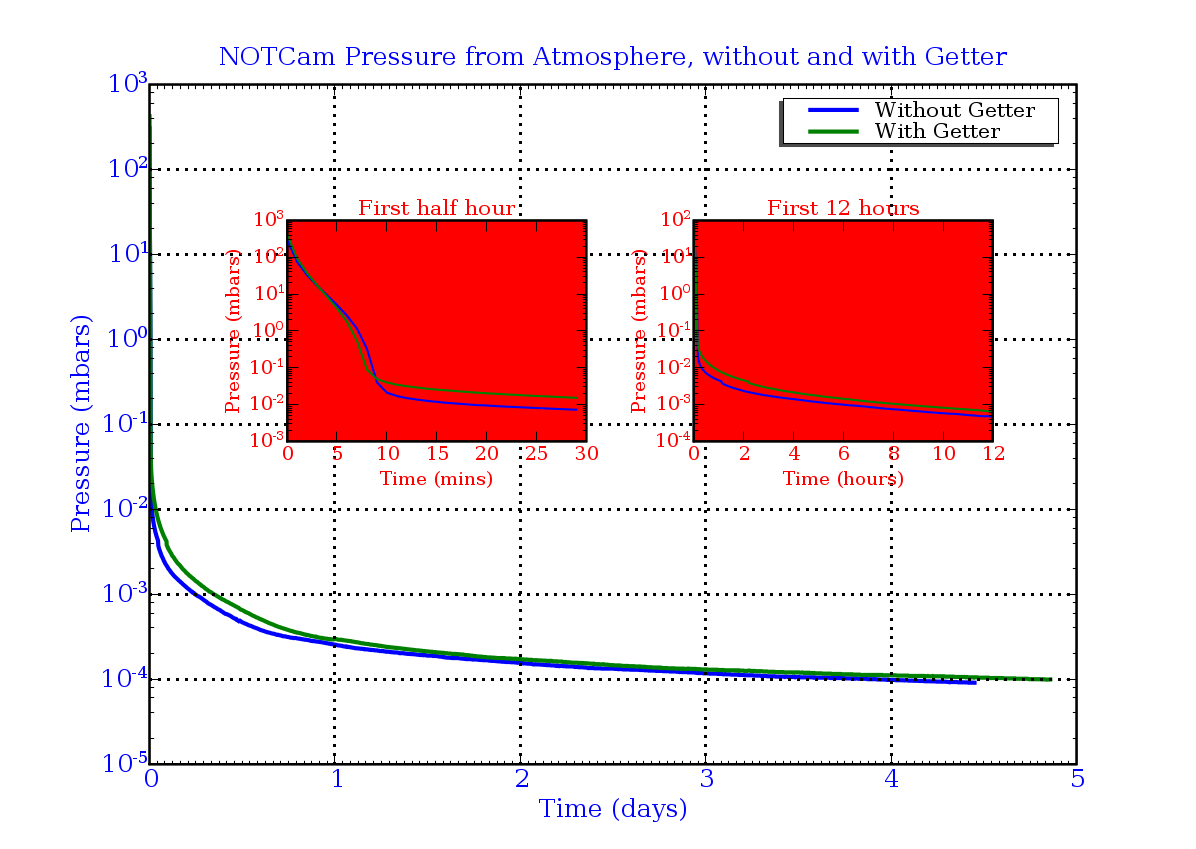
starting the vacuum pump. After 8 hours of pumping: 1.0E-02 mbar.
After 24 hours: 2.4E-03 mbar. After 48 hours: 1.0E-03 mbar. After 3 days:
5.7E-04 mbar. (Dewar temperature still 20 degrees.) No vacuum loss
during transport to the dome! After 4 days of pumping: 2.4E-04 mbar
(no cooling). After 5 days: 1.3E-04 mbar. PTR started after 5 days and
4 hours of pumping.
|
| 2006-11-07 |
PTR rotary valve replacement unit |
The rotary valve replacement unit for the PTR arrived from Iwatani
(Japan) and was tested on the instrument. Unfortunately, it failed to cool
and had a strange out-of-phase sound (compared to the old working unit).
The old unit is still working like a clock, but it has been running for
more than 27000 hours while a replacement is recommended after 15000 hours.
|
| 2006-10-05 |
New Science Array arrived! |
The new Science Array from Rockwell arrived and is stored safely
until installation in NOTCam.
|
| 2006-08-28 |
Improved filter focus offsets |
In good seeing conditions (FWHM 0.3''-0.5'') the focus offsets for
the filters YnJHKs were determined for both the WF and the HR camera.
These values can be found in the NOTCam User's Guide. The focus is wavelength dependent so
these values should be good also for the narrow band filters.
|
| 2006-08-28 |
NOTCam BIAS upgraded |
Upgrade of the data acquistion software BIAS with the inclusion of a
new clean-array command clear and some bug fixes.
|
| 2006-08-22 |
PTR compressor oil filter replaced |
PTR maintenance: the compressor oil filter was exchanged with a
new refurbished unit from Iwatani after a run time of 28316 hours.
|
| 2006-07-12 |
NOTCam opening
Bad vacuum |
Because of bad vacuum NOTCam was warmed up on July 12th and moved to the
SB. Opened on 18/8. The inside of the vessel was cleaned. Charcoal baked. The
procedure of mounting the getter was made easier in order to speed up the time
from taking the getter hot out of the owen to the start of vacuum pumping.
Closed on 22/8.
|
| 2006-06-12 |
Error in FITS keyword FILT2ID for J filter |
Note an error in the FITS header keyword FILT2ID for the J-band filter
in the period January to June 2006, where the FILT2ID value, which refers
to the
NOT filter number, was 210 instead of the correct value 201.
|
| 2006-05-11 |
Light reduction |
Four masks are installed in the stop wheel for light reduction purposes.
If you have a very bright target you can use a 9mm, 7mm, 6mm, or 5mm
opening rather than the default 15mm one to get a throughput of 38%, 22%,
15%, or 10%, respectively. To be further tested.
|
| 2006-05-11 |
Engingeering grade array re-installed |
The engineering grade array was installed again in NOTCam on May 2nd. Its
behaviour seemed normal in the warm state. Reached operating temperature on
May 11th. Quality Control shows that gain is ~3 e/adu and readout
noise ~10-12e, i.e. as before. Alignment OK. Updated
zero-point magnitudes.
|
| 2006-04-22 |
NOTCam BIAS
documented |
The NOTCam data acquisition software has been documented.
|
| 2006-april |
NOTCam opening
Science Array not well behaving |
NOTCam was warmed up after the run 7-11 April and moved to the clean room
and opened. A number of tests were made but nothing obvious was found.
In the warm state none of the quadrants worked well, however. Cooling down again
showed that all quadrants were bad even at operating temperature. The cause is
unknown but the Science Array is useless and will be taken out.
|
| 2006-04-07 |
One quadrant dead |
Quadrant #3 was found non-responding on the 7th of April. The remaining
three quadrants worked well and gave the normal values of read noise
and gain. The observing run was modified to dither the targets within
the three working quadrants. The reason for the problem is not
understood. The instrument had not been opened since December and the
new array worked well since installation. After the previous NOTCam run on
March 15th there had been a case of a non intended warm-up because the
PTR had turned off and the email warning monitoring of NOTCam
temperatures had failed. NOTCam was pumped and cooled again.
|
| 2006-01-14 |
Science Array zeropoints |
The zeropoint magnitudes for NOTCam with the Science Array were found on
the photometric night 14/1-2006 to be: 24.02, 23.97, and 23.33 for J, H,
and Ks, respectively. Note that the zeropoints are for 1 e/s,
not 1 ADU/s. The gain is 2.2 e/ADU. The Exposure
Time Calculator was updated in April.
|
| 2006-01-14 |
First stars with Science Array |
Weather allowed for the first technical night on the sky with the Science
Grade Array since its installation. A JHKs image of a stellar cluster can be
seen here. The image scale was measured to be
0.234''/pix.
|
| 2006-01-14 |
Multi Extension Fits (MEF) format |
Commissioning of the MEF data format, the new User Interface
software, and the upgrade of the data aquisition computer from
elizabeth to marissa. The FITS keywords are upgraded. See
New data formats and FITS headers.
|
| 2005-12-26 |
Vacuum losses remedied |
The origin of the problem of occational losses of vacuum upon LN2
spilling (at low altitudes and when the fill tube is lower than
the vent tube) as well as during LN2 filling has been found. The
vent tube extension is renewed with a thinner tube which is not in
contact with the outer tube. The way the fill tube is
blocked while observing is refined in order to avoid the inner
tube getting contact with the outer tube, which causes temperature
stresses on the o-rings and thereby vacuum losses.
|
| 2005-12-22 |
NOTCam opening
Vacuum
problems |
NOTCam was set to warm up on the 22/12 after an observing run of
Venus at very low altitudes. It was found that thermal stresses on
the vent tube o-rings caused vacuum leaks when LN2 was spilling out
from the vessel as its orientation would be at very low altitudes.
|
| 2005-10-26 |
Science array commissioning (report) |
First cold tests of the Science array was made on the 25th
of October. NOTCam was then mounted on the telescope on the
26th. Cosmetics, flat field, linearity and QE is much better
than for the engineering grade array. For details check the
NOTCam Science Array page. Bad weather did not allow
opening the dome. Zeropoints and backgrounds must be checked
later.
|
| 2005-10-20 |
Science array installed! |
The engineer grade array was taken out and the science array
was installed in NOTCam. The procedure has been documented
with pictures here
(limited access). Tests performed to verify that the
array can be read out.
|
| 2005-Oct |
NOTCam opening
Exchange of bearings
+ other work |
All worm wheel bearings were exchanged. The new bearings were
first lubricated with MOS2 - this time while rotating the
bearings to get a homogeneous layer. All wheels tested and
worked fine. The entrance wheel did not turn smoothly, and
wheel teeth were marked by the strong pressure from the spring
between the two halves of the worm gear. This was fixed by
modifying some spacers.
The Balzer pressure sensor was cleaned.
The LN2 fill and vent tubes were opened for the first time and
examined. Some oxidized parts were cleaned. The outer o-ring in
each tube was found deformed. This could be the cause of some
recent vacuum losses occuring every time we fill with LN2. New
o-rings were mounted.
The 4 narrow-band Östlin filters were taken out.
|
| 2005-07-20 |
NOTCam opening
Poor vacuum |
Because of poor vacuum and holding time we decided to warm-up
NOTCam. The holding time became merely 2 days and kept decreasing.
NOTCam was pumped on the 9/8 while at a temperature of 15 deg
C and a starting pressure of 37 mbar. After one hour 2.5e-03
mbar, and after 24 h 3.2e-04 mbar was reached. The PTR was
started after 51 h of pumping. 12 h later the array was at
-22 deg C in a vacuum of 4.78e-05. LN2 was filled 9 h after
this, when the array was at about -50 deg C, and it took 24
hours more for the array to reach -196.3 (vacuum 7.6e-05 mbar).
The holding time could not be properly checked, but was at least
better than 3 days.
|
| 2005-Jun |
No increase of dead pixels |
The previously mentioned large
number of "dead pixels" (that in addition seemed to come and go)
were not actually dead! Investigation of the reset frame
(i.e. the pre-read) showed that its peak histogram level had drifted
from about 4000 ADUs towards zero. Pixels with zero or negative values
in the reset frame, would end up as zero valued pixels in the
resulting image (i.e. the end-of-integration frame minus the reset
frame) because the program would set them so. This caused an apparent
presence of dead pixels. Only slight modifications to the bias offset
voltages were needed to adjust the reset frame level back to its
original state.
Thus, the bottom line is that the actual number of dead pixels in
this array is around 1%, and that this number has been all the time
the same.
We suspect the origin of the problem is some drift in the array itself.
And from now on we will regularly monitor the reset frames.
|
| 2004-Nov |
NOTCam opening
Focus pyramid installed |
NOTCam has now a focus pyramid, similar to the one in ALFOSC, installed in the
grism wheel. It is made of IR grade fused silica (Heraeus Infrasil 302), cemented
together with a vacuum grade cement and held together by a spring metal frame.
The pyramid post-processing software calculates the offset in telescope
focus units from the correct focus and needs in principle only one image obtained.
Makes NOTCam observing a lot more efficient.
|
| 2004-02-12 |
No further dead pixels |
When NOTCam had reached operating temperature on 12/2 a number of
darks were taken to estimate the number of dead pixels. There has
been a continuous increase with every thermal cycle during 2003.
To our positive surprise there was no increase between now and the
previous opening. The number of dead pixels measured on the
12/2-2004 was on the contrary only 2.5%. Dead pixels seem to come
and go.
|
| 2004-02-05 |
Closing and leak test |
The anodized masks made to limit scattered light for both HR
and WF imaging mode were installed. The 128 micron WF slit was taken
out. Screws and nuts put on the 64 micron WF slit, but not strongly
tightened. Then all wheels tested to initialize well, and all
temperature sensors checked. The pressure sensor was replaced with
a spare (old Hirac). The hot getter installed and NOTCam closed and
set to vacuum pump. He leak test performed: no leak (i.e. value less
than 2.0E-8 units on RGA). Continue pumping.
|
| 2004-01-29 |
NOTCam opening
Leak test |
We made a leak test of NOTCam with He gas and
the Residual Gas Analyzer. No leak was found, and
we concluded that the pressure sensor is unreliable
and will be replaced by a new one as soon as possible.
(From now on we will perform leakage tests upon every
closing of NOTCam to make sure the vacuum will be OK
before transporting it to the dome. A
leak testing procedure (limited access) has been put on the web.
Then NOTCam was opened and the three new Ostlin
filters were mounted. The Grism2 filter was taken
out.
|
| 2003-12-10 |
Dead pixel evolution |
NOTCam has been warmed up six times during 2003, and the
number of dead pixels
has increased from 1% in Jan-2003 to 5% in Dec-2003 (given
as percentage of dead pixels of the total 1024x1024 array).
The detector is still
the engineering grade array. The dead pixels
mainly cluster along the left edge.
|
| 2003-11-10 |
NOTCam opening
Exchange of bearings |
NOTCam was opened in the clean room for the very
first time, as it now has its own table with a lifter
such that the lid can be hooked up from the ceiling.
We have exchanged
all the worm wheel gear bearings to
avoid further hick-ups. The new bearings have been
lubricated by MOS2. Some of the old bearings were
found to be very worn. A document was made on
How to exhange bearings (limited access). Two recently
arrived filters (Z and He IA) were installed. The focus
mechanism was taken apart to find out what type of
bearings are used.
|
| 2003-09-05 |
Pick-up noise removed! |
Over the summer months the work on reducing
the persistant
pick-up noise
gave results. The readout noise is now
close to specs for both readout modes, and the
stripes are almost completely gone.
|
| 2003-08-19 |
NOTCam opening
Timeouts on filterwheel 1 |
Problems with stuck filterwheel during the service
observations forced another warm up and opening. One
bearing in the worm wheel drive of filterwheel 1
was this time exchanged. 10 days is about what is needed
for a full warm-up, opening and cool-down cycle for
NOTCam. See
Fault report (limited access). |
| 2003-08-07 |
NOTCam spectroscopy: first light! |
First light for spectrosopic mode!
Check
Commissioning report for status and progress. |
| 2003-06-20 |
NOTCam opening
Grism #1 installed |
The first NOTCam grism was installed in the grism wheel,
and a grism holder mask was made. The Ostlin filters were taken
out and found to have cracked top coatings. Returned to the
provider. NOTCam closed 24/6, transported to
the dome 26/6, PTR turned on 30/6, filled
with LN2 1/7, and cold by 3/7. |
| 2003-05-12 |
NOTCam opening
Installing Östlin filters |
Filters arrived in the last minute and got
installed, instrument closed 12/5. Problems in
the startup of the pumping procedure, and the
instrument barely reached operating temperature
when observations started on the 17/5. The cold
table temp. sensor had been broken. |
| 2003-04-22 |
Stable arrray temperature |
Since using the PTR also with NOTCam mounted
at the telescope, the array temperature is now
much more stable throughout the night. It has
been measured to deviate only 0.1 degree over the
whole night for typical nights. This of course
depends on the amount of LN2 that might be spilled.
|
| 2003-04-07 |
NOTCam opening
Filterwheel 2 + other work |
The problem with filter wheel 2 was located to one of the wheel
bearings, which had become stuck. A spare one was cleaned and then
lubricated with MOS2 to replace the broken one, and the wheel now
moves fine. The Balzer pressure sensor was cleaned
according to
this method (limited access only).
One filter in filterwheel 1 which had become a bit lose in
its holder was tightened by putting in a new copper spring.
NOTCam was closed and started pumping on
2/4 after having verified that all wheels
initialized well. The getter was baked again
at the JKT at 150 degrees for about 4 hours.
It takes 75 minutes before the pump reaches
operating speed at 75 KRPM. By then the
pressure was down to 1.2 10-1 mbar.
After 4 hours pumping, P = 5.1 10-1 mbar.
Transported to the dome on 4/4. Pumping continued.
PTR started on 5/4. LN2 filled morning 6/4. NOTCam
reached operating temperature 7/4 around midday.
|
| 2003-03-27 |
Warm-up time ~ 3 days |
Verified that the init switches worked
OK and concluded that the sounds from the
wheel and motor indicated a mechanical problem.
Decided to open NOTCam. Found that by moving
NOTCam early to the SB, warm-up time is about
3 days from turning off the PTR. The last day
of LN2 filling was 5 days before turning off
the PTR.
|
| 2003-03-17 |
Filter wheel timeouts |
Timeouts on filterwheel 2 during a visitor
run. Could be initialized only using tty to
run the UIF and on repeated trials. Was run
with a fixed filter setup for each night the
rest of the run. See
Fault report (limited access only).
|
| 2003-03-12 |
PTR vibration tests |
No technical problems. New PTR vibration test data obtained,
and no deterioration found down to a best seeing of 0.5'' FWHM.
Student training. New linearity test data obtained for both
readout modes. Photometric standards in broad and narrow band
filters. One night lost to useless weather. Testing of the
"buzzer", the device which is designed to monitor the shutter
behaviour and give warning alarms if it fails.
|
| 2003-02-24 |
Leak testing using RGA |
NOTCam was transported back to the dome and tested for leakage
using Helium gas and the RGA. No leaks found, except for a very
minor leak around the amplifier boards, which has probably always
been there.
|
| 2003-02-20 to 21 |
NOTCam opening
Slits and masks
installed |
NOTCam was opened. Getter baked in owen at JKT.
Slit mounts designed and fabricated. Two slits mounted. Four
hartmann masks mounted. Dummy grism test mounted. Two redundant
filters taken out and two new filters installed. Collimator position
marked. Pressure sensor found to be unreliable, a factor of 10 wrong.
Should be cleaned next time. The roughing pump in the new pump is not
capable of pumping NOTCam.
|
| 2003-01-16 |
PTR long hoses installed |
PTR long hoses installed. First test with
PTR running when NOTCam is mounted on the
telescope. Vibration tests showed no effect of
the PTR down to a best seeing of 0.9'' FWHM for
this night. Photometric standards. Snow and ice
on the hatch impeded opening upper hatch all
the way, and zenith distances less than 15 deg
had to be avoided. No problems with the long
hoses at any rotator/altitude positions.
|
| 2002-09-22 to 25 |
Commissioning |
Four half nights of which 20% was lost to
bad weather. Focus tests of both cameras. Standards
for both cameras. Experienced once that the shutter
was hanging. Some narrowband filter testing.
|
| 2002-09-16 |
11th commissioning run (1/2n) |
Photometric weather. Photometric standards
observed in JHKKs with both cameras, also across
the FOV to check the photometric scatter.
Check results.
|
| 2002-August |
Warm-up and pump |
NOTCam was brought to the service building
and warmed up. No opening became necessary. Was
pumped and cooled again.
|
| 2002-06-01 |
10th commissioning run (1n) |
First photometric night since shutter was
OK! Many hours lost to miscellaneous problems
as this was the first night after the M1 and
M2 aluminisation procedure. Pointing model
observations were made, as well as StanCam
zeropoints.
One photometric standard observed in
H and K with the WF camera.
|
| 2002-05-13 |
Six months cold |
NOTCam has been kept cold for half a year and it
is clear that during storage the detector is kept
stable at -183 to -190 degrees by the PTR alone.
Variations follow the variation in ambient temperature.
|
| 2002-04-01 |
First Visitor run! |
NOTCam was offered in visitor mode for the first time.
The observing run was 7 nights. No time lost to problems!
Half of the time lost to rain and snow, however.
Juke box automatically
burning around 26 CDs per night. |
| 2002-03-29 to 31 |
9th commissioning run (3n) |
Totally lost to rain. The CD burning juke box was
ready for use. |
| 2002-03-18 |
NOTCam BIAS |
BIAS bug fixes and changes. |
| 2002-01-26 to 28 |
8th commissioning run (3n) |
Mostly lost to thick clouds, some data taken through
thinner clouds. |
| 2002-01-02 to 03 |
7th commissioning run (2n) |
First night useless weather. Second night commissioning
test data obtained. No technical problems. |
| 2001-12-25 |
Shutter now fixed!
6th commissioning run (5n) |
Useless weather. Shutter now finally behaves perfectly.
No timeout on any wheels. First reliable noise and linearity
test data obtained! |
| 2001-11-30 |
Shutter speed modified |
The time it takes to rotate the shutter 90 degrees was
changed from 100ms to 150ms. Extensive testing shows this
seems to have solved the problem. A closed loop solution is
being looked into where the shutter position verification is
done automatically. |
| 2001-11-27 |
5th commissioning run (2n) |
Shutter more unreliable than ever. Observations were repeatedly
interrupted during the first night. The second night NOTCam was run
with the shutter disabled. Some commissioning proposal targets done.
|
| 2001-10-29 |
NOTCam opening |
The stuck filterwheel was caused by the nut of a screw that had
become stuck in the motor gear. All wheels, shutter and focus run
well during extensive testings before closing NOTCam.
|
| 2001-10-07 |
4th commissioning run (2n) |
No data obtained. Useless weather. Stuck filterwheel.
Shutter does not operate
well.
|
| 2001-09-08 |
3rd commissioning run (4n) |
The high resolution camera was installed for this run and the two
cameras are found to have foci almost within the range of instrument
focus travel at the same telescope focus. A small modification will
be necessary to ensure that it is not necessary to change telescope
focus when changing cameras. All filters are installed. This run
made it clear that normal operations will require two observers to
make optimal use of the instrument and the NOT archive system need
vastly increased bandwidth (a project which is already underway).
More commissioning-time science programmes were executed.
|
| 2001-08-20 |
NOTCam opening
Filter wheel
stuck
HR camera installed |
Installation of the HR camera.
|
| 2001-08-10 |
2nd commissioning run (2n) |
The instrument was kept cold between the first two
commissioning runs to allow us to gain experience with long term
storage. A very small leak appears to be present. During this period,
a number of software problems were resolved. The second commissioning
run itself was less successful than the first with a stuck filter wheel
and loss of synchronisation of the shutter.
|
| 2001-07-01 |
1st commissioning run (2n) |
The first commissioning run was very successful with no
critical failures of the instrument at all. A considerable amount of
verification data was collected and we were even able to collect some
scientifically useful data. The biggest problem identified was how to
prevent liquid nitrogen spilling from the dewar. Some small modifications
may be necessary.
|
| 2001-06-30: |
FIRST LIGHT! |
30 days of intense effort paid off with the first light image being on
target and in focus, greeted with applause in the control room and broad smiles
all around. |
| 2001-06-30: |
NOTCam is mounted on the telescope |
It fits!
|
| 2001-06-15 |
First "recognisable" images on La Palma |
Give a geek a camera costing several hundred thousand Euros, and
what will he do with it...? |
| 2001-06-01: |
NOTCam arrives on La Palma |
NOTCam arrives on La Palma, apparently undamaged, and work begins immediately
to bring the instrument into condition for use at the telescope.
|
| 2001-03-30: |
First recognisable images |
The new engineering grade detector has been
installed in Copenhagen and the dewar cooled without a hitch. The
detector was then used to obtain recognisable images through both
cameras, the first such images obtained with this instrument.
Final electromechanical and cryogenic tests are underway;
the next step is to align the optics.
|
| 2001-03-19: |
Status |
NOTCam is still in Copenhagen. The mechnical
destruction of the engineering grade detector late last year forced a
new delay while we redesign the detector mount to avoid breaking the
new one as well. The precise cause of the breakage is not known, so
we are being careful to make sure that all possibilities are covered.
We cannot, at this time, predict when NOTCam will arrive in La Palma
nor when it will be available to the community, but we are doing our
best to proceed as quickly, and as safely, as possible.
|
| 2000-03-09 |
Electromechanics, PTR & Controller |
All electromechanical systems now function correctly.
Leaks have been found in the Iwatani PTR hoses and are being repaired
in the USA.
Controller work continues with highest priority at CUO.
|
| 2000-02-28 |
SPIE paper |
Paper submitted to SPIE describing NOTCam and current progress:
"SWIR at the Nordic Optical Telescope: NOTCam",
Abbott et al. 2000, SPIE 4008,
p. 714-719 . A poster will be presented at the SPIE meeting in Munich
at the end of March.
|
| 1999-11-15 |
Controller & MUX |
The MUX has been run in the test dewar, producing an image.
|
| 1999-11-01 | 3rd Cooldown |
Detector mount now achieves operating temperature, but very slowly (72 hrs).
Pressure in dewar still increases while closed (stable at ~10-5 mbar).
No contamination on window.
No heat path through window mount.
Cooling power is ~15W.
LN2-only hold time: ~44hr.
Before cooldown: PTR wick installed, anodization cleaned off PTR & window flanges and cold shield, cooling braid to detector mount installed, Nextel removed
from hemispherical baffle cover, dewar not baked(?).
|
| 99-10-15 | Warmup |
Warmup rate is 38°/day. 6 days from cold to ambient.
Contaminant haze present on window.
No contamination on witness slides.
|
| 99-10-11 | 2nd Cooldown |
Detector mount does not achieve operating temperature, but sensor later found
to be compromised.
Four 25l bottles of LN2 used for initial
cooldown.
Cooling power: ~22W.
LN2 hold time: ~31hr.
Some cooling of window flange noted.
Fill tube found to be potentially dangerous.
RGA spectrum while cold appears clean.
Before cooldown: charcoal getter installed, hemispherical baffle trimmed by
~3 mm, dewar not baked.
|
| 99-09-30 | 1st Cooldown |
Lowest uncooled pressure: ~5×10⁻⁵ mbar.
Condensation on window.
Motors run while cold.
Before cooldown: standard 2-day bake.
|
| 99-09-29 |
CUO/NOTSA contract addendum mailed out |
|